Pulse and counting
Music has a heartbeat: the pulse. It keeps going, steady, with the same gap every time, even when the notes stop. In this chapter you feel it, count it out loud, and keep it going at the piano.
A steady beat
A steady beat has the same gap every time, like your heartbeat, a ticking clock, or your feet when you walk.
Not steady means the gaps change: shorter, longer, a stop, then go again. The beat of music is steady.
Pat your knees with both hands 8 times, the same gap every time, like a clock. Then walk 8 steps across the room, one step on each beat.
Count out loud
Give every beat a number: 1 2 3 4, then start again at 1. Say it out loud, one number on each beat, the same gap every time.
Counting out loud keeps the beat steady. Later it tells you where every note goes.
Pat your knees and count 1 2 3 4, four times round, without stopping. Then play one black key on every beat and keep counting.
When the notes stop
The beat does not stop when you stop playing. Play on 1 and 2, lift your hand on 3 and 4, and keep counting. The silent beats still count. Then you come back in at the right time.
A dashed circle is a silent beat: count it, but don't play it.
Beat or rhythm?
The beat is the steady heartbeat underneath. The rhythm is the pattern of sounds on top, long and short, like the sounds of words.
Say bird on one beat: one sound. Say tur-tle on one beat: two sounds. The beat stays the same and the rhythm changes.
Tap the beat with your foot and say bird, tur-tle, bird, tur-tle, one word on each beat. Then clap the words while your foot keeps the beat.
The beat in your fingers
Now the fingers take turns, a new finger on each beat. Play each row twice and count out loud: 1 2 3 4. The numbers in the coral circles are finger numbers, so they never get mixed up with the count.
- Small-house beatRight hand, fingers 2 and 3 on the black keys of the small house. One circle is one steady beat.23232323
- Big-house beatRight hand, fingers 2, 3 and 4 on the black keys of the big house.23432343
- Left-hand beatLeft hand, fingers 3 and 2 on a small house lower down.32323232
My five checks
Show each one at the piano.
Keeping the beat
- I can pat a steady beat: the same gap every time
- I can count out loud, 1 2 3 4, while I pat
- I can keep counting through silent beats
Beat and rhythm
- I can tell the beat from the rhythm: my foot keeps the beat, my hands clap the words
- I can play a new finger on each beat and count out loud
Free worksheet
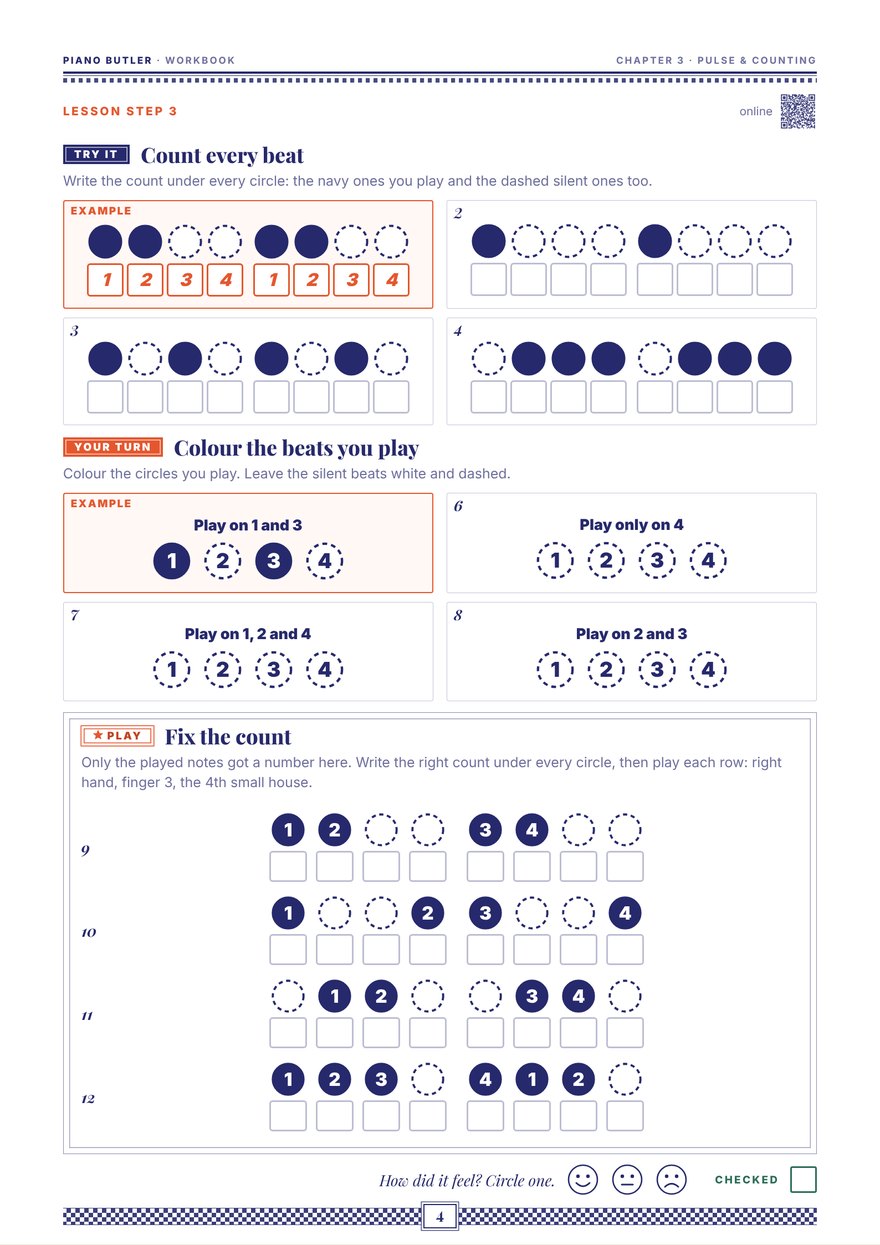
Silent beats still count
Write the count under every beat circle, the played beats and the silent ones. Colour the beats to play from a short instruction. Then fix rows where only the played notes got a number. One A4 page.
Print this pageThe whole chapter: Lesson Book + WorkbookTry it on screen
The same lesson with moving parts that listen to your taps, and a five-level drill: steady or not, tap along with the click, keep it going on your own, count inside and tap one beat, and tap the beat, not the words.
Open the lessonCommon questions
What is the pulse in music?
The pulse is the steady beat underneath the music, like a heartbeat. It has the same gap every time, and it keeps going even when the notes stop.
What is the difference between the beat and the rhythm?
The beat stays steady underneath. The rhythm is the pattern of long and short sounds on top, like the sounds of words. Saying "bird" on one beat makes one sound; saying "tur-tle" on one beat makes two. The beat is the same, the rhythm is different.
Why should beginners count out loud?
Counting out loud keeps the beat steady, and later it tells you where every note goes. It also carries you through the silent beats, so you come back in at the right time.
How do you count beats in music?
Give every beat a number, 1 2 3 4, and start again at 1, one number on each beat. When the notes get quicker, the count grows with them, always as the time signature counts: 1 + 2 + 3 + 4 +, then 1 e + a 2 e + a. The + is read "and".
What should you do when the notes stop?
Keep counting. A silent beat is still a beat: lift your hand, say the number, and come back in on the next note at the right time.