Keyboard patterns
The piano looks like 88 different keys, but it is one small pattern, repeated. Learn the pattern first, and you always know where you are on the piano.
Small house, big house
The black keys are the roofs of the houses. Two black keys together are the roof of a small house; three are the roof of a big house. Small, big, small, big: the same two houses repeat all the way up the piano. Look for the shapes, not the single keys.
- 2 black keys = the small house's roof.
- 3 black keys = the big house's roof.
- Low on the left, high on the right. The street climbs from under the sea, where the turtle swims, up into the sky, where the bird flies.
The white keys of each house
A white key is never just anywhere: each one lives under a roof. Under the small roof live 3 white keys (the left door, the inside and the right door); under the big roof live 4. Three and four make seven, and after seven the street starts again.
This grouping is the key idea of the chapter. A student who sees it finds every note name from the pattern, instead of counting up from the bottom of the piano.
The whole piano and middle C
A real piano has 88 keys, 52 white and 36 black, yet it is still only the two houses: 7 small ones and 7 big ones. At the very bottom lives one lonely black key with no house at all.
Count the small houses from the bottom up to the 4th one: its left door is middle C. Middle C is the ground: go right and the notes climb up into the sky, higher and higher; go left and they dive down under the sea, lower and lower.
Play on the patterns
The first tunes need no written notes at all: just the black-key roofs and fingers 2, 3 and 4. The right hand plays on the big roof, the left hand's 2 and 3 on the small roof. Fingers 1 and 5 come later, with the C position.
- Hot Cross BunsRight hand 2 3 4 on the big roof. One circle is one steady beat.43243222223333432
More tunes to play by finger numbers in the online lesson: Mary Had a Little Lamb, Old MacDonald, and Rain Rain Go Away.
My five checks
Show, don't tell: each one is shown on the keyboard.
On the keyboard
- I can find a small house and a big house anywhere
- I can say each house's white keys: 3 and 4
- I can hear high and low, and show the turtle's end and the bird's
And playing
- I can find middle C, just left of the 4th small house
- I can play Hot Cross Buns legato with 2 3 4
Free worksheet
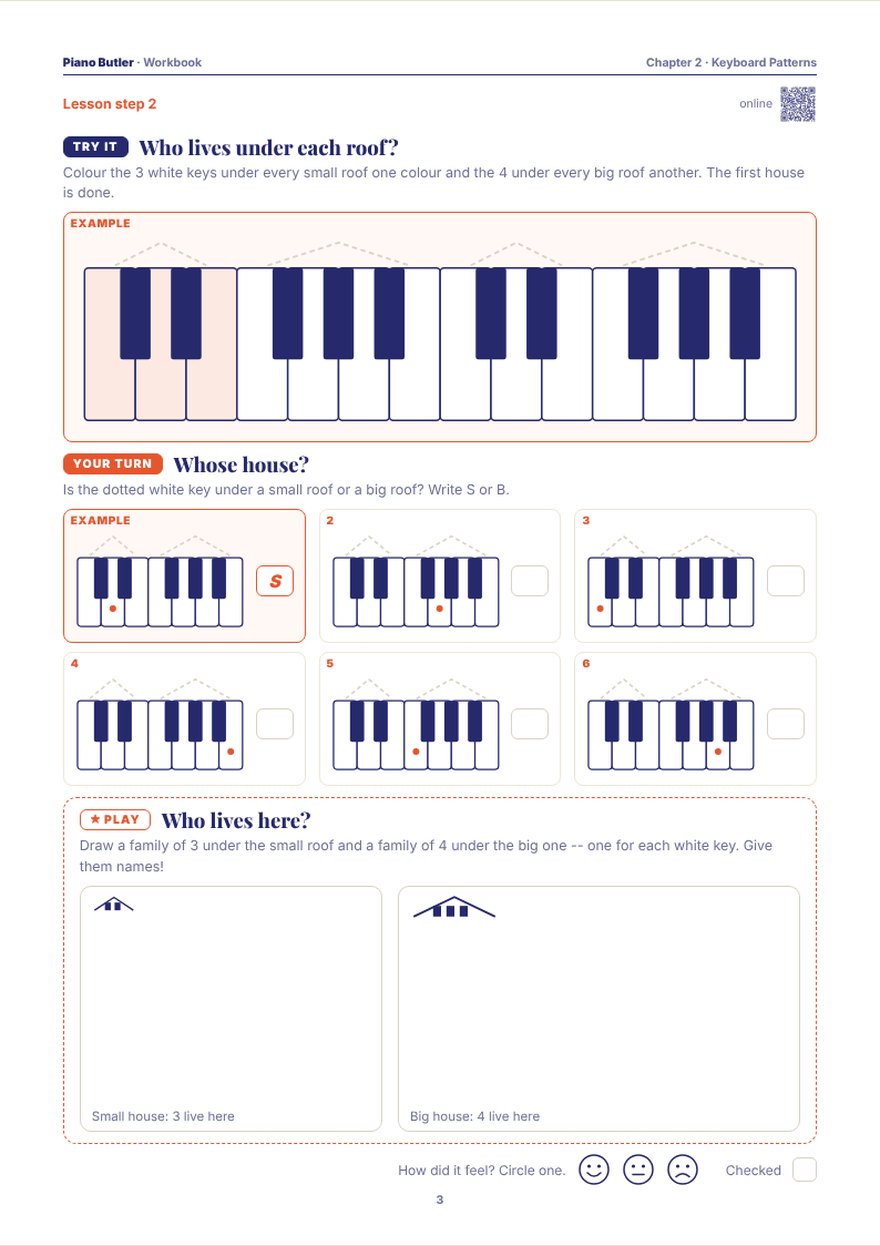
Who lives under each roof?
Colour the 3 white keys under every small roof and the 4 under every big roof, decide whose house six dotted keys belong to, then draw the two families. One A4 page.
Print this pageThe whole chapter: Lesson Book + WorkbookTry it on screen
Tap a white key and watch its whole house light up, count the houses on all 88 keys, and play Hot Cross Buns, Mary Had a Little Lamb, Old MacDonald and Rain Rain Go Away by finger numbers.
Open the lessonCommon questions
How do you find middle C on a piano?
Count the groups of two black keys from the bottom of the piano. At the 4th group, the white key just to its left is middle C.
Why learn the black keys before the note names?
The black keys come in groups of two and three, and every white key belongs to one of those groups: three at the group of two, four at the group of three. Once that pattern is seen, every note name can be found from it instead of by counting.
How many keys does a piano have?
88: 52 white keys and 36 black keys. The same pattern of two and three black keys repeats seven times, with one extra black key at the very bottom.